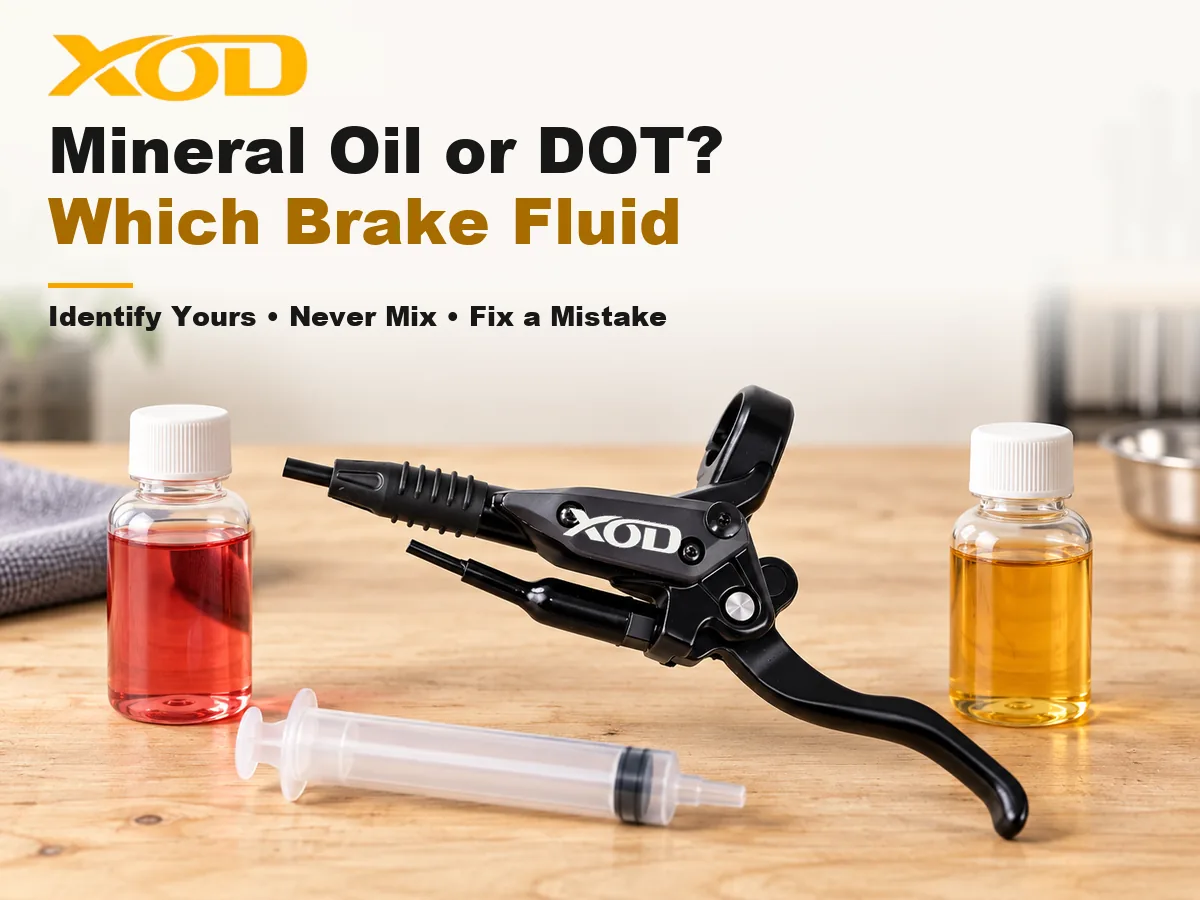
You want to top up or bleed a hydraulic scooter brake, and the shop sells red, green, blue and clear bottles. Or something already went in and you are not sure it was right. Here is how to find out which fluid your brake takes.
What riders often ask
- My brake fluid is one colour and the new bottle is another. Can I top up?
- My brake was filled with fluid from a car shop. Is that a problem?
- Do new XOD brakes arrive with oil inside?
Jump to a section
The two fluid families Which one is yours? Does colour matter? Why never mix Car fluid and substitutes Wrong fluid went in XOD brakes FAQWhat are the two kinds of brake fluid?
Hydraulic brakes use either mineral oil or DOT brake fluid. Each brake is built for one of them.
Wikipedia's brake fluid article explains the DOT side. DOT 3, DOT 4 and DOT 5.1 are based on glycol ether, like most brake fluid in use today. DOT 5 is based on silicone and stands apart. Mineral oil is a third type, used in some bicycle brakes. Our XOD H-Series uses it too.
The main practical difference is water. Glycol-based DOT fluids absorb moisture from the air. Mineral oil and silicone fluid do not. Fluid that has taken up water boils at a lower temperature, which matters when a brake gets very hot, as on long descents with a heavy load.
| Family | Base | Absorbs water? | Mixing rule |
|---|---|---|---|
| Mineral oil | Mineral oil | No | Never with any DOT fluid |
| DOT 3, DOT 4, DOT 5.1 | Glycol ether, the usual car brake fluid | Yes | Never with mineral oil or DOT 5 |
| DOT 5 | Silicone | No | Not with any other brake fluid |
Neither family is the better one to pick. As Wikipedia's bicycle brake article puts it, the O-rings and seals inside a brake are designed to work with one fluid or the other.
How do I tell which fluid my scooter brake takes?
Read the brake, then the maker's documents. The marking and the manual decide. Colour and guesses do not.
- Find the brand of the brake on the lever and the caliper. It may differ from the brand of the scooter.
- Check the reservoir. On a full hydraulic brake it is usually part of the lever unit. The Wikipedia bicycle brake article notes that the reservoir is usually marked with the type of fluid to use. Look for "mineral oil" or a DOT grade.
- Check the caliper for the same marking.
- Open the maker's manual or product page. As an example, the specification list on our XOD H-Series universal kit page reads "Hydraulic Fluid: Mineral oil".
- Ask if nothing is marked. Park Tool's bleeding guide says to contact the brake manufacturer for model-specific information if in doubt. Add nothing until you know.
Check the exact model, not only the brand. If a seller's answer names mineral oil and a DOT grade together, ask again, because they are two different fluids.
Does the colour of the fluid tell me which type it is?
No. Colour is not a reliable way to identify brake fluid, and it is not a specification.
According to the Wikipedia brake fluid article, DOT-compliant fluids must be colourless or amber, except DOT 5 silicone, which must be purple. Fluid that is in use, or not labelled DOT compliant, is found in any colour.
So a red, green or blue bottle tells you nothing certain, and neither does clear fluid in your brake.
Colour was never the rule. Two things matter: whether the bottle is the fluid your brake maker names, and whether you know what is in the system now. If both are known and they match, top up or bleed by the maker's procedure. If the level has dropped, look for a leak before you add anything, and do not ride on a leaking brake. If either is unknown or they do not match, add nothing and ask the maker.
Why must mineral oil and DOT fluid never be mixed?
Because the seals in a brake are made for one fluid family. The wrong one damages them, and that can lead to brake failure.
Park Tool states the rule in its hydraulic brake bleeding guide: never use DOT brake fluid in brakes designed for mineral oil, or the other way round. It also says never to share bleed kits between the two systems. A syringe that has held car brake fluid should not touch a mineral-oil brake.
The Wikipedia bicycle brake article describes the result. The seals can fail, the lever can turn soft, and the caliper pistons may no longer retract, so the pads scrape on the disc.
Brake makers say the same in their own documents.
| Maker document | Fluid it names | About other fluids |
|---|---|---|
| Our XOD user manual (H-Series) | Mineral oil | Do not mix with DOT3, DOT4, DOT5 or DOT5.1. Incompatible fluid may damage the hydraulic seals and can result in brake failure. |
| Tektro's bleed procedure | Tektro-branded mineral oil only | Other disc brake fluids, especially DOT-based ones, will harm the system. |
| A SRAM service manual for mineral-oil brakes | Only the mineral brake oil SRAM names | No DOT 4 or DOT 5.1, and no other oil or fluid. After DOT contamination the entire brake system must be replaced. |
All three name a mineral oil, and two name one specific product. "Mineral oil" is a family, not a single fluid.
Can I use car brake fluid, baby oil or another brand of mineral oil?
Not unless your brake maker says so. Car brake fluid is almost always DOT fluid, and household or engine oils are not brake fluids.
Car brake fluid
Most fluid sold for cars and motorcycles is glycol-based DOT fluid. It must never go into a mineral-oil brake. If your brake is a DOT system, use only the DOT grade its maker names.
Baby oil, cooking oil, engine oil
A bottle at home may say "mineral oil", but that word is not a brake specification. Tektro tells owners to use only its own branded mineral oil. SRAM's manual says not to use any other oil or fluid, because it will damage the system and make the brakes unsafe. Neither approves a household or engine oil.
Another brand of mineral oil
Brake mineral oils are not all the same. The Wikipedia bicycle brake article notes that their boiling points vary with the type. Use the oil and the viscosity your brake maker names, do not blend brands on your own, and ask the maker before you top up a system you do not know.
What should I do if the wrong fluid went in?
Stop riding and contact the brake maker before you do anything else. Do not assume that a bleed puts it right.
Stop riding if DOT fluid went into a mineral-oil brake, mineral oil went into a DOT brake, or you do not know what was added. Also stop if fluid is leaking, the lever has gone soft or the pads drag. Have an experienced mechanic check the brake before you ride again.
- Park the scooter. A lever that still feels firm does not prove the seals are unharmed.
- Write down what went in: the product, roughly how much, and when.
- Contact the brake maker or seller and follow the answer. For its mineral-oil brakes, SRAM states that a system contaminated with DOT fluid must be replaced completely, lever and caliper included, because the seals degrade and the brake is unsafe to use.
- Do not rely on a flush. Bleeding changes the fluid. It does not renew a seal.
- Check the pads. If fluid reached them, they are contaminated. SRAM and Tektro both say contaminated pads must be replaced.
If it is an XOD brake, stop riding and message us with the same details. Damage caused by incompatible hydraulic fluid is outside our commercial warranty, so ask before you pour.
If braking feels weak or grabby afterwards, have the brake checked before you ride. A leak is more urgent: Tektro's document treats leaking oil as a sign of potential brake failure and says not to continue riding. Our manual says the same: stop riding, find and repair the leak, then bleed and test.
Which fluid do XOD brakes use, and does a pre-bled kit need oil?
XOD H-Series brakes use mineral oil only, never DOT. Our KuKirin kit page states that the brakes come pre-bled, so a normal installation does not start with filling the system.
Our hydraulic brake FAQ gives the same answer as the manual: XOD hydraulic brake systems use mineral oil, and incompatible fluid can damage seals and other hydraulic components.
You need mineral oil only in the cases our manual lists for bleeding: the lever feels soft or spongy, the hose was opened, disconnected or shortened, the oil was replaced, or air may have entered. If the lever is soft, look for a leak first: a bleed does not repair a leak, and if you see oil outside the brake, stop riding. If none applies and the lever is firm, leave the system closed.

If you ride a KuKirin and want a hydraulic kit that arrives already bled, check the options listed for your model.
- Options listed by KuKirin model and by front, rear or full set
- Comes pre-bled; mineral-oil system
- Dedicated adapter cable option for G2 / G2 Ultra / G4
- A pre-bled brake already holds its oil. Watch the split-hose installation video in our manual before you connect the hose, and do not open a bleed port unless you need to bleed. Not sure if your kit is pre-bled? Ask us.
- Oil is not on the box list. The list on our universal kit page names the caliper, lever, hose, pads and mounting hardware. Mineral oil and a bleed kit are not on it.
- Ask us before you buy oil. Our bleed guide says to use compatible hydraulic mineral oil, never DOT fluid. It also notes that we do not currently sell mineral oil, because international shipping restrictions on liquids can make it impractical, so riders buy it locally or from a marketplace. Do not choose by colour, and send us your kit model before you buy a bottle so we can check it with you.
For the procedure, use our XOD bleed guide. It has the steps, a video, and a section on tools and where to buy a bleed kit and mineral oil. If you are not experienced with bleeding, our manual recommends an experienced installer. Between bleeds, include lever feel and a look for oil at the lever, hose and caliper in your routine brake checks.
Scooter brake fluid FAQ
Can I put DOT fluid in a mineral-oil scooter brake?
No. The seals are not made for DOT fluid, and Park Tool, Tektro and SRAM all warn against it. If it has already happened, stop riding and contact the brake maker.
Can I use car brake fluid in my scooter brakes?
Only if the brake is a DOT system and its maker names that DOT grade. Most car brake fluid is glycol-based DOT fluid, which must never go into a mineral-oil brake such as the XOD H-Series.
Can I mix two brands of mineral oil?
Not on your own. Brake mineral oils are not all the same, and the makers cited here tell owners to use the oil they name. Ask your brake maker before you top up with a different brand.
Is red brake fluid different from green or blue?
Colour cannot tell you. Wikipedia describes a colour rule for DOT-compliant fluids only, and notes that other fluids are found in any colour. Compare the bottle label with the marking on your brake.
I added the wrong fluid. Can I bleed it out and keep riding?
Do not ride, and do not rely on a bleed. Bleeding changes the fluid but cannot renew a seal. Contact the brake maker with what went in and when. For XOD brakes, contact us.
Do XOD brakes come filled with oil?
Our KuKirin kit page states that the brakes come pre-bled, and that a bleed may be required if hoses are shortened. For another XOD kit, check its page or ask us. Mineral oil is not on the box list of our universal kit page. Use a compatible mineral oil only, never DOT, and send us your kit model before you buy so we can check it with you.
Tell us your kit model and what you plan to do. We will check your kit with you before you buy oil, and whether you need to bleed at all.
Ask us before you buy oil →Email service@xodbrakes.com
12-month limited commercial warranty against manufacturing defects on the main caliper and master-cylinder bodies (eligible xodbrakes.com retail purchases) · Photo fit check before you order