

Your brakes feel fine in town. Then a long hill, a heavy load or a fast scooter makes them go weak when you need them most. This guide explains why heat does that and what to do about it, on any brand of brake.
What riders often ask
- I am a heavy rider. On long downhills my brake gets weaker near the bottom. Is something wrong?
- Partway down a mountain road my lever comes closer to the grip. Is that fade, or air in the line?
- Can I count on electronic braking downhill, and why does it do less on some rides?
- I live in the hills and wear out pads fast. Which pads, rotors or calipers suit a heavy, fast scooter?
Jump to a section
What fade is Friction or fluid fade On the descent Electronic braking Check before buying What to change FAQWhat is brake fade, and why do weight and long hills cause it?
Brake fade is a drop in stopping power after long or repeated braking, and its cause is heat. Wikipedia's article on brake fade says it is most likely under high load or high speed, and occurs most often in high-performance driving or when going down a long, steep hill. It can affect any vehicle with friction brakes, motorcycles and bicycles included.
A brake turns the energy of movement into heat in the pads and rotor, and the rotor passes that heat to the air. Three things decide how much heat arrives:
- Total weight. Rider, scooter and load all count. More mass means more energy in every stop.
- Speed. Energy rises with the square of speed, so a little more speed adds a lot of heat.
- The hill. On a descent, gravity keeps adding energy and the brake gets no pause to cool.
Many scooter rotors are small and thin, so they have little metal to hold heat. Our KuKirin G2 2026 fitment guide lists the older G2 with 1.9mm × 140mm rotors and the G2 2026 with 1.9mm × 160mm.
Friction fade or fluid fade: which one do I have?
The lever tells you. If it stays firm but the scooter slows less, the pads and rotor are overheating. If it goes soft and moves closer to the grip, the fluid is overheating.
Wikipedia describes friction fade as a pedal that feels firm with reduced stopping ability. In fluid fade the fluid boils and releases gas that can be compressed, so the pedal feels spongy, and fluid contaminated with water makes it worse. On a scooter, read lever for pedal. A fully mechanical disc brake, where the cable moves the pads directly, has no fluid, so only the first kind applies to it. A cable-pulled hydraulic caliper still holds oil at the caliper, so treat it as a hydraulic brake here.
| What you notice | What is happening | What to do |
|---|---|---|
| Lever firm, less slowing after long braking | Friction fade: pads and rotor too hot | Stop, let it cool, then review pads and rotor |
| Lever soft during the descent, firm again when cold | Fluid fade: heat has reached the fluid | Stop riding and let it cool. Do not finish the descent on that brake, even if it firms up. Have the system inspected and bled before you ride hills again |
| Lever soft even when cold | Air, low oil or a leak. This is not fade | See our guide to a soft or spongy brake lever |
| Weak all the time, hot or cold | Worn or contaminated pads, no bed-in, or air in the system | Check pads, bed-in and air before you ride hills |
Riders often ask whether a lever that creeps toward the grip on a mountain road is fade or air. Check it cold. Firm before the ride and soft only near the bottom points to heat. Soft before you set off points to air, low oil or a leak, the causes our manual lists for a spongy lever.
Stop riding if the lever goes soft, pulls to the grip, pulses or loses pressure, if you see oil at the caliper, hose or lever, or if braking does not return after cooling. Our manual says to stop riding immediately on a leak or loss of hydraulic pressure. Walk the scooter down and have an experienced mechanic inspect it. Oil at the caliper or hose is a hydraulic brake leak: our manual says to find and repair it, then bleed and test the brake before you ride.
What should I do on a long descent?
Keep your speed low from the top, brake in firm bursts with full releases, use both brakes and stop to cool as soon as the feel changes.
- Check before the hill. Each lever should feel firm and each wheel should spin freely. A dragging pad heats the rotor before you brake; see why hydraulic brakes rub.
- Start slow. Pick a speed you can hold from the top. Wikipedia notes that heavy vehicles use engine braking and slow down, so that braking energy is spread over a longer time.
- Brake in bursts. Squeeze progressively to below your target speed, release fully, let the speed build, then repeat, without locking a wheel. Wikipedia's advice, written for cars and trucks, is that periodic braking lets the brakes cool between applications, while continuous light braking can be particularly destructive in both wear and heat.
- Use both brakes. Two rotors share the heat. A scooter with only one friction brake puts all of it into that brake.
- Stop when the feel changes. Less bite, a longer pull or a new pulsing in the lever is your signal. Pull over safely and let the brake cool in the air. Do not pour water on a hot rotor and do not touch it.
- Test before you continue. If the lever went soft, pulled closer to the grip or pulsed at any point, do not ride the rest of the descent, even if it feels firm again once cold. Walk the scooter down and have the system inspected and bled before you ride hills again, and have the rotor checked if the lever pulsed. If the lever stayed firm, did not pulse and the bite has fully returned, make one gentle stop at walking pace first.
Wikipedia notes that faded brakes usually perform as well as before once they have cooled. Pads that stayed very hot for a long time can glaze, leaving a smooth, shiny surface that grips less well. If the brake stays weak afterwards, inspect the pads.
Can electronic or regenerative braking do the job instead?
No. It lowers the heat your pads and rotors must take, but it cannot be your only brake.
Wikipedia's article on regenerative braking states that it is not sufficient by itself as the sole means of slowing a vehicle as required or bringing it to a standstill, so it must work with a friction brake. The effect drops off at lower speeds and normally acts only on wheels that have a motor.
How strong it is, and when the scooter reduces it, is set by the scooter's controller. Riders often ask why it does less on some rides, for example after a full charge. That depends on the model, so check the scooter's manual, and set up the friction brakes to handle the whole hill alone.
What should I check before I buy parts?
Check the brake you already have. A worn, dragging or poorly bled brake has less in reserve.
- Pads. Our manual says to replace worn pads before the friction material becomes excessively thin. Use your pad maker's limit.
- Bed-in. Our manual says new pads and rotors need a bedding-in period, and warns against relying on maximum braking force straight after installation. Keep fresh pads off mountain roads until then.
- Drag and oil. The wheel must spin freely. The manual also says to keep oil and grease off pads and rotor and to replace seriously contaminated pads.
- Fluid. If the lever went soft from heat even once, have the system inspected and bled before you ride hills again. Our manual says XOD H-Series brakes use mineral oil only, never DOT. See mineral oil or DOT and how to bleed XOD hydraulic brakes, or use an experienced mechanic.
- Rotor. SRAM's brake tuning guide, written for mountain bikes, reads the colour on the rotor's arms as a heat check: purple or rainbow discolouring means the rotor runs too hot and a larger size is needed, while browned or bronzed means the size suits. Also check the rotor for wobble and wear.
What can I change on the scooter if it keeps fading?
Work in this order: pad compound, rotor size, then caliper. Each step is a bigger job than the last.
1. Pad compound
SRAM's brake pad overview says sintered pads are ideal for heavy or extreme duty where resistance to higher temperatures is required, such as a steep sustained descent. SRAM adds that organic pads tend to wear faster, and that sintered pads need a more thorough bed-in and tend to be louder. Among our replacement brake pads, we list the copper-based compound for heavy electric scooters and the full-sintered compound as the heavy-duty choice for high temperatures. The pad shape must match your caliper, and not every caliper and rotor is made for sintered pads, so check your brake maker's pad rating before you switch. SRAM also states that if you switch pad compounds you will need to replace your rotors.
2. Rotor diameter
A larger rotor gives the caliper a longer lever arm and has more metal and surface to take up heat. SRAM's tuning guide says the recommended size depends on what the frame and fork accept, on rider and bike weight, and on riding style. Our universal brake rotors come in 140, 160, 180, 203 and 220mm. A bigger rotor moves the caliper outward, so it needs a matched mounting adapter and enough clearance. Our universal H-Series kit page lists 140, 160, 180 and 203mm rotors, our KuKirin kit page lists 140 and 160mm, and our adapters come in versions for 160, 180 and 203mm rotors, so send us a photo of the caliper and mount before you size up.
3. Rotor thickness
A thicker rotor has more metal to absorb heat, but the caliper must be made for it. Our rotors come in 1.9, 2.3 and 2.9mm, but not every thickness is listed in every diameter, so check the exact rotor option with us before you order. Our GT-Series page states that the four-piston XOD GT-Series requires a 2.9mm rotor, and that a thinner disc can easily lead to oil leaks and caliper seizure. For an H-Series caliper, do not change rotor thickness on a guess. Send us a photo of your caliper and rotor before you order and we will check it with you.
4. Two pistons or four
Our FAQ says four-piston systems are better suited to uses that need greater clamping force and heat control, including heavier vehicles. That does not make them right for every scooter: our series guide lists vehicle weight, tyre grip, rotor size, brake pads, installation and fitment as things that all affect braking.
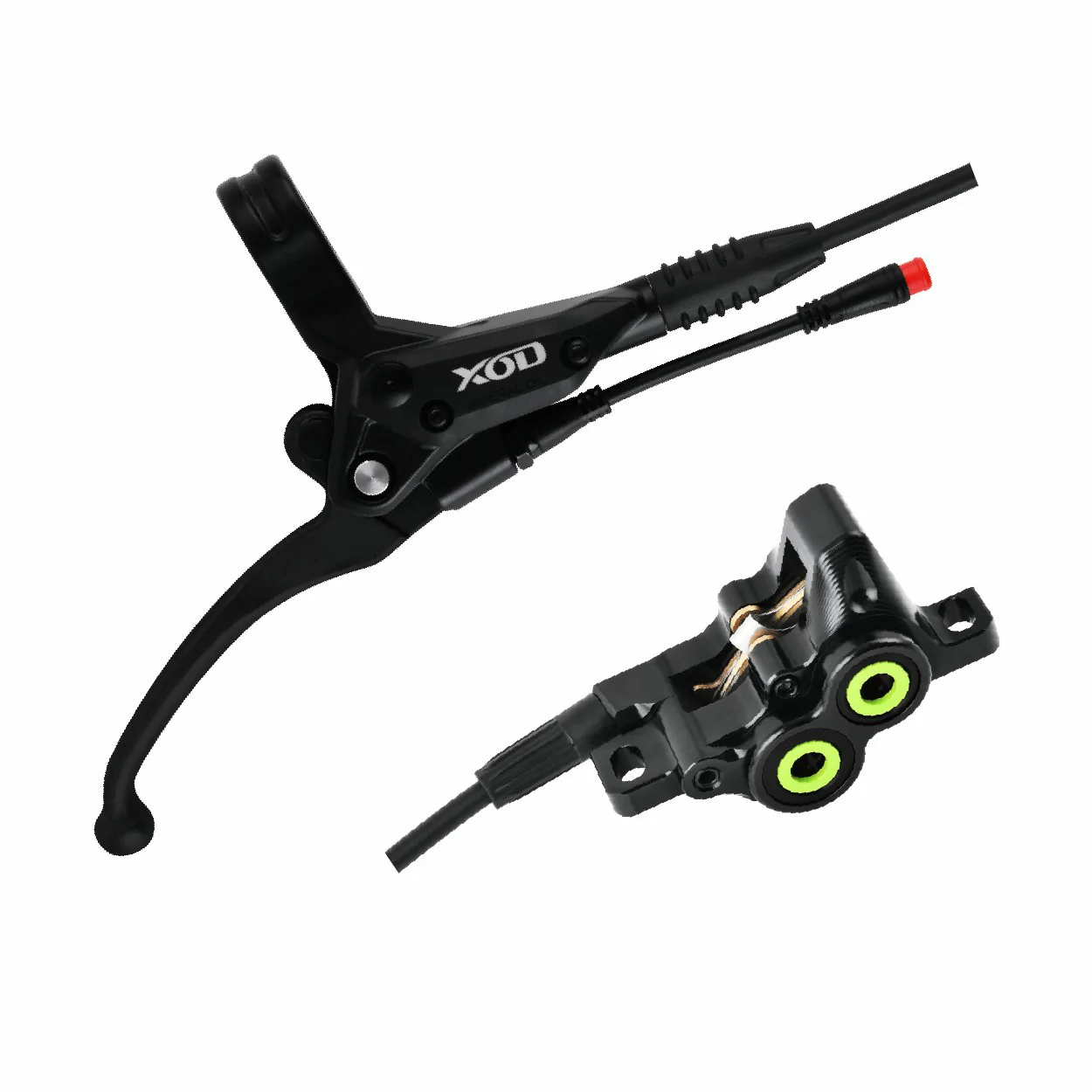
For a heavy or fast scooter that still fades after a pad and rotor change, the GT-Series is our four-piston option, once fit is confirmed.
- One-piece 4-piston caliper (GT400, GT401, GT402, GT500)
- Requires a 2.9mm-thick rotor
- Levers with power-off sensors; heat-dissipation pads pre-installed
No part changes the physics: a heavier load or a faster descent still makes more heat, so keep the technique after any upgrade.
Scooter brake fade FAQ
What does brake fade feel like on an electric scooter?
The brake works normally at first, then slows the scooter less after long or repeated braking. With friction fade the lever stays firm. With fluid fade it goes soft and moves closer to the grip.
Do brakes work again after they fade?
Usually. Wikipedia notes that faded brakes usually perform as well as before once cooled. Pads that stayed very hot for a long time can glaze and grip less, so test at walking pace first. If the lever went soft at any point, do not ride the rest of the descent, even if it feels firm again once cold. Walk the scooter down and have the system inspected and bled before you ride hills again.
Can I rely on regenerative braking downhill?
No. It takes some load off the pads, but Wikipedia's article on regenerative braking states that it is not sufficient as the sole brake and must work with a friction brake. Keep the friction brakes able to handle the hill alone.
Which brake pads suit a heavy rider or long descents?
SRAM describes sintered pads as ideal for heavy or extreme duty where resistance to higher temperatures is required, such as a steep sustained descent. They tend to be louder and need a more thorough bed-in. Match the pad shape to your caliper, and check that your caliper and rotor are rated for sintered pads. SRAM also says that if you switch pad compounds you will need to replace your rotors.
Will a bigger or thicker rotor stop brake fade?
A larger rotor has a longer lever arm and more metal to deal with heat, so it helps, but it is not a cure on its own. Thickness must suit the caliper. Our GT-Series page states that GT-Series brakes require a 2.9mm-thick rotor. For an H-Series caliper, send us a photo of your caliper and rotor before you order any rotor and we will check it with you.
Tell us your scooter model, the total weight it carries and the hills you ride. Add photos, so the pad, rotor and caliper choice is checked before you order.
Ask for a photo check →Email service@xodbrakes.com
12-month limited commercial warranty against manufacturing defects on the main caliper and master-cylinder bodies (eligible xodbrakes.com retail purchases) · Photo fit check before you order